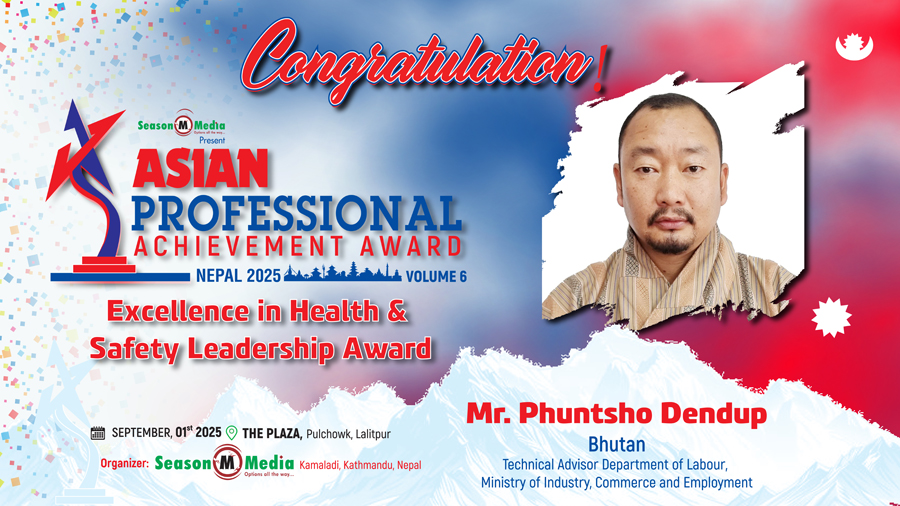
Thimphu, Bhutan From the quiet valleys of Shingkhar, Bumthang, to the forefront of national labour reforms, Mr. Phuntsho Dendup has emerged as one of Bhutan’s leading voices in occupational health, workplace safety, and labour administration. With nearly two decades of dedicated service, he has shaped key national frameworks while championing the rights of vulnerable workers.
Currently serving as Technical Advisor at the Department of Labour, Ministry of Industry, Commerce and Employment, Mr. Dendup has been instrumental in advancing a culture of prevention and safety across the country. His leadership has driven initiatives such as the development of Occupational Health and Safety (OHS) regulations and standards, the formulation of the National OHS Strategy, workplace hazard assessments, and the design of training guidelines that set new benchmarks for Bhutanese workplaces.
In 2025, he spearheaded Bhutan’s first-ever National OHS Seminar, creating a groundbreaking platform for dialogue, research exchange, and knowledge sharing among experts, policymakers, and practitioners.
A strong advocate for vulnerable groups including women, children, and migrant workers Mr. Dendup has ensured that Bhutan’s workplace policies are inclusive and gender-responsive. His work has safeguarded maternal health in the workplace, addressed child labour in hazardous sectors, and strengthened protections for foreign workers engaged in high-risk industries.
Previously, as Interim CEO for Foreign Workers Management, he led reforms in foreign labour recruitment, introduced safer workforce management systems, and aligned skills mapping with the country’s sustainable employment goals. He played a key role in the revision of Labour and Employment Act Regulations (2022), the OHS Regulation 2022, and the development of Bhutan’s first National OHS Profile.
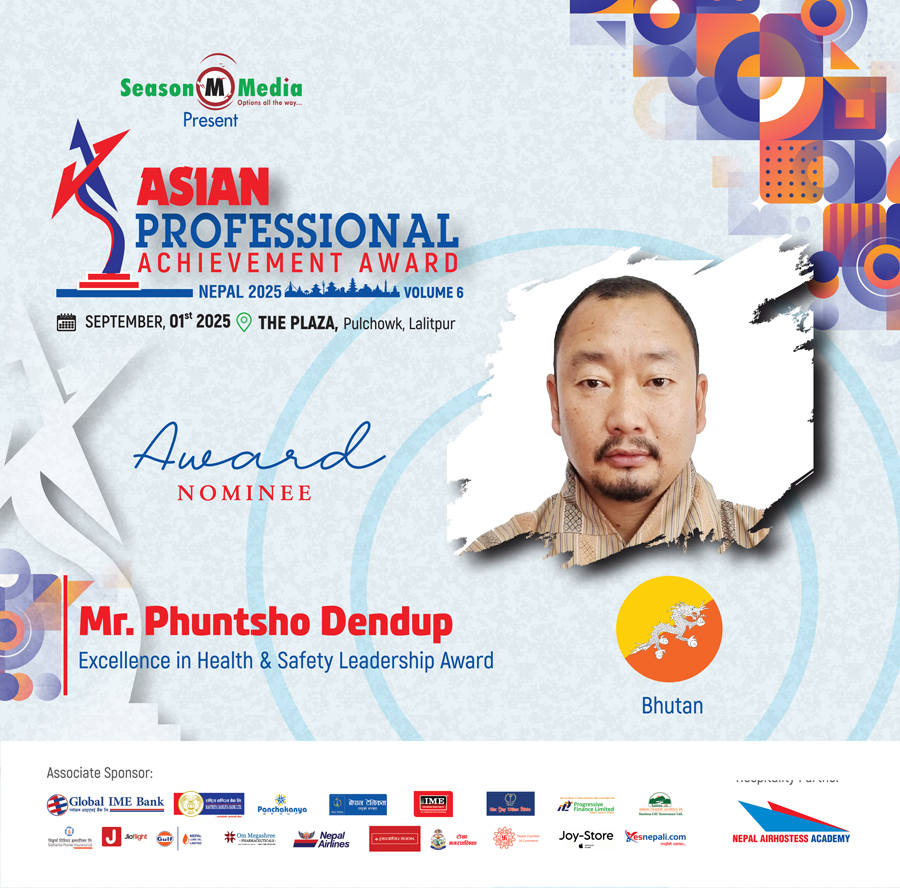
Beyond policy and advisory roles, Mr. Dendup is also an active researcher and academic. His studies—published in both national and international journals cover diverse topics such as workplace accidents, occupational noise exposure, hearing loss, gender perspectives in OHS, and construction safety practices. He has presented at several international conferences, bringing Bhutan’s perspectives to the global stage through cross-country research collaborations.
His contributions extend well beyond government service. As Vice-Chairperson of the Shingkhar Dechenling Welfare Association, he has worked on socio-economic welfare, youth engagement, and the revival of cultural traditions. He also serves as Deputy Project Director of the Shingkhar Lhakang Reconstruction and Restoration Project, a spiritual and cultural initiative of national importance.
Reflecting his deep roots in Bhutan’s cultural and spiritual heritage, Mr. Dendup continues to emphasize that development must go hand-in-hand with cultural preservation and community resilience.
“Every worker deserves a safe and healthy workplace, regardless of gender, age, or background,” he says, reaffirming his lifelong commitment to labour rights and community well-being.
From humble beginnings in Shingkhar to becoming a national figure in workplace safety, Phuntsho Dendup’s journey is a testament to Bhutan’s evolving vision of sustainable development one where progress is built on dignity, equity, and collective responsibility.
यो खबर पढेर तपाईलाई कस्तो महसुस भयो ?
[WPAC_LIKE_SYSTEM]प्रतिक्रिया
सम्बन्धित खवर