Written By: Rezina Tuladhar
Perhaps migration is no longer just about seeking a better education or earning more money. Perhaps it is about wanting a life where hard work feels rewarding, opportunities are accessible and the future feels secure.
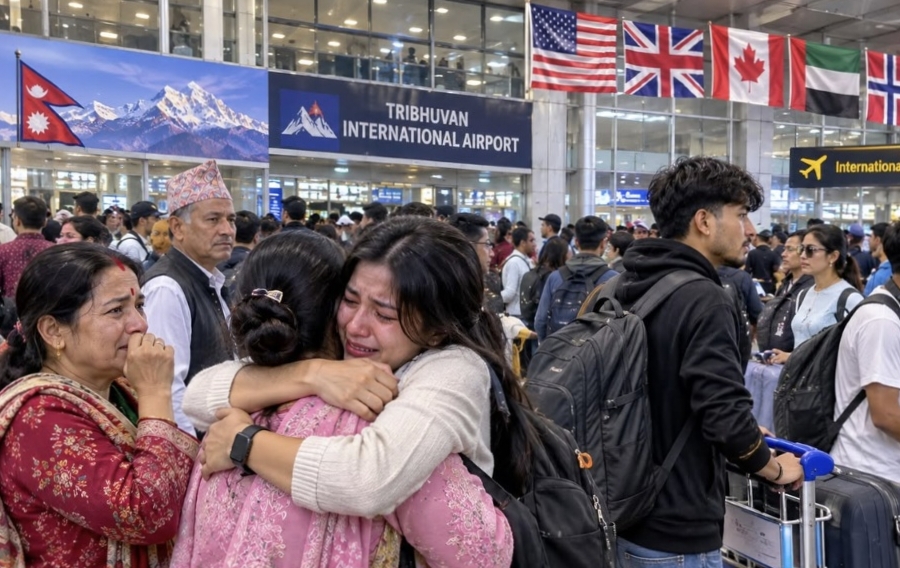
There was a time when going abroad was mostly associated with young students. After completing their +2 education, many would dream of leaving Nepal for further studies, better exposure and what they believed would be a brighter future. For many families, sending their children abroad became a symbol of hope, progress and opportunity.
But today, something has changed.
It is no longer just teenagers and young graduates looking beyond Nepal. People in their 30s and 40s are also considering migration. Some are established professionals, some are entrepreneurs, some have spent years working in the private sector, and others have already built businesses and careers here.
This makes me wonder: What exactly are we failing to provide as a country that people at such different stages of life are looking for a future elsewhere?
I believe the reasons go much deeper than education or salary.
We ask our children to study, but do we teach them how to become independent?
In Nepal, we place enormous importance on education. After SEE, it is +2, then a bachelor’s degree, followed by a master’s degree. Parents want their children to study hard, achieve good grades and secure a respectable future.
There is nothing wrong with that aspiration. Every parent wants the best for their children.
But somewhere along the way, we have forgotten that education is not just about textbooks and examinations. It is also about learning responsibility, independence, financial management and the value of earning through one’s own effort.
In many countries, students have the opportunity to work part-time, take temporary jobs, participate in internships or earn through seasonal employment. These opportunities allow them to manage their personal expenses, understand the value of money and gain practical working experience while continuing their education.
In Nepal, however, such opportunities are still limited and often lack proper structure.
We expect our young people to concentrate entirely on their studies, yet we do not create enough opportunities for them to earn even for their small personal requirements.
Imagine how valuable it would be if a student could work a few hours a week, earn their own pocket money, contribute towards their expenses and learn workplace discipline.
Perhaps we would be preparing them not just to pass examinations, but to face life.
For many young people, going abroad offers exactly this combination: education, work experience and a sense of independence.
But what about those who are already 30 or 40?
This is where the conversation becomes even more interesting.
A person in their 30s or 40s is generally not leaving Nepal simply to experience a foreign country. By this stage, many have already invested years in their careers, businesses and personal lives.
They may have responsibilities towards their parents, children, spouses, employees and families.
They have worked hard, gained experience and contributed to the economy. Yet many still find themselves questioning whether they can achieve financial stability in Nepal.
For a salaried individual, having a respectable designation does not necessarily mean having a comfortable life.
Monthly income must cover household expenses, children’s education, rent or housing loans, transportation, healthcare, family responsibilities and savings for the future. When the cost of living continues to rise but salaries do not keep pace, even a well-qualified and experienced professional can feel financially stretched.
At some point, the question becomes very personal:
After working for 15 or 20 years, should I still be struggling to secure the future of my family?
People are not always looking for luxury. Sometimes they simply want the comfort of knowing that their hard work will allow them to save, invest, provide for their children and live with dignity.
Being an entrepreneur in Nepal is not always easy
There is another group we rarely discuss enough: business owners and entrepreneurs.
Starting a business requires courage. It takes investment, patience, risk-taking and years of hard work to establish something meaningful.
Yet running a business in Nepal can sometimes feel like an entirely different challenge.
Business owners have to deal with registrations, renewals, taxation, compliance requirements, administrative procedures and changing regulations. While rules and regulations are necessary in every country, they must also be practical, transparent and predictable.
Small and medium-sized businesses, in particular, often struggle with administrative burdens and uncertainty.
An entrepreneur should ideally spend more time thinking about growth, innovation, customers and employment generation, rather than constantly worrying about procedural complications.
What entrepreneurs need is not freedom from regulation. They need a system that supports genuine business activity, rewards compliance and makes it easier to operate with confidence.
When someone who has invested years of effort and money begins to feel that running a business elsewhere may be more predictable, it is worth asking why.
Are we making it easier for people to build businesses in Nepal, or are we unintentionally making them consider building those businesses somewhere else?
We pay taxes, but do we feel the difference?
Citizens understand that taxes are necessary. Businesses understand that they have responsibilities towards the state.
But people also expect something in return: efficient public services, reliable infrastructure, better healthcare, quality education, accountability and a system that respects their time and effort.
The frustration often comes when people feel that their obligations keep increasing while the quality of public services does not improve at the same pace.
It is not about avoiding taxes. It is about wanting to feel that contributing to the country also means receiving a functioning system in return.
People want to believe that their efforts are contributing to a country that is moving forward.
The biggest loss is not just the number of people leaving
When a young person leaves Nepal, we often say we have lost another student.
When an experienced professional leaves, we lose years of knowledge, experience and expertise.
When an entrepreneur leaves, we may lose someone who could have created jobs, trained young people and contributed to the local economy.
When families settle abroad, future generations may grow up with fewer reasons to return.
And when this happens repeatedly, we must think beyond individual migration decisions and look at the larger picture.
Remittances undoubtedly support Nepal’s economy and millions of households. They help families educate their children, build homes and meet daily expenses. But we should also ask ourselves whether a country can sustainably depend on sending its people abroad rather than creating enough opportunities for them at home.
According to the World Bank, remittances account for a substantial share of Nepal’s economy, reaching around a quarter of GDP in recent years. This is both an economic strength and a reminder of how dependent our livelihoods have become on opportunities outside our borders.
Perhaps we are asking the wrong question
We frequently ask young people why they want to leave Nepal. We ask parents why they are sending their children abroad. We sometimes question why experienced professionals and business owners want to start over in another country.
But perhaps we should ask ourselves a different set of questions.
What kind of opportunities are we creating for our young graduates?
Can a person working in the private sector realistically afford a decent standard of living?
Can an entrepreneur confidently plan a business five years ahead without worrying about unpredictable policies?
Can an experienced professional see a promising future in Nepal?
Can a family feel financially secure without having to depend on someone earning abroad?
These are not unreasonable expectations. They are the basic things people look for when deciding where to build their lives.
Nepal should be a place where people want to stay, not a place they feel they have to leave
I do not believe everyone should stay in Nepal. Migration is a personal choice, and international exposure, education and employment opportunities can be wonderful experiences.
Nor should we discourage people from exploring the world.
But there is a difference between leaving because you want to explore opportunities and leaving because you feel you have no reasonable alternative.
That difference deserves our attention.
A teenager wants an opportunity to learn and earn. A young professional wants career growth. A person in their 30s wants stability. Someone in their 40s wants to know that the years of hard work they have invested will eventually provide security for their family.
Different ages, different responsibilities, but perhaps one common expectation: the opportunity to live a better and more secure life.
Nepal does not need to convince people to stay through emotional appeals about patriotism alone. It needs to create an environment where staying makes practical sense.
We need better opportunities, fairer systems, predictable policies, meaningful employment and an administration that understands the realities of ordinary citizens, employees and entrepreneurs.
Because loving your country and wanting a better life are not opposing ideas.
Perhaps the real question is not why so many Nepalis dream of leaving.
Perhaps the real question is:
What will it take for Nepal to become a country where people can dream, work hard, build businesses, raise families and grow old without feeling that their best opportunities lie somewhere else?
यो खबर पढेर तपाईलाई कस्तो महसुस भयो ?
[WPAC_LIKE_SYSTEM]प्रतिक्रिया
सम्बन्धित खवर