Rezina Tuladhar/yesnepali.com
Kathmandu, 27 April Nepal contributes less than 0.1% to the global greenhouse gas emissions. Yet, it has boldly committed to achieving ‘net-zero emissions’ amidst the global climate crisis. It is commendable that a country with such a small carbon footprint is making policy efforts to safeguard its future, existence, and development path. However, Nepal’s approach, as reflected in its Third Nationally Determined Contribution (NDC-3), raises critical questions about whether its priorities truly align with the principles of climate justice—or if they are more influenced by international pressure and the lure of financial support.
Under the Paris Agreement, adopted at the 21st Conference of Parties (COP21) of the UN Framework Convention on Climate Change (UNFCCC), countries pledged to limit global warming to well below 2°C, preferably to 1.5°C. Every five years, countries must submit updated NDCs and implement a more refined transparency framework under Article 13 of the Agreement. Nepal submitted its first and second NDCs in 2016 and 2020, respectively. Now, preparing for the 2025 deadline, Nepal has submitted its NDC-3 with updated emission reduction and climate adaptation targets.
The Imbalance in Nepal’s NDC-3 Priorities
A closer look at NDC-3 reveals a striking imbalance: out of 40 pages, 22 are devoted to mitigation (emissions reduction), while only five pages cover adaptation efforts and two pages address loss and damage. This overwhelming focus on carbon reduction seems disconnected from Nepal’s lived realities. As one of the world’s ten most climate-vulnerable countries, Nepal suffers massive losses every year from floods, landslides, wildfires, hailstorms, droughts, and other extreme weather events.
In reality, for Nepal, climate adaptation and loss mitigation are immediate existential needs—more urgent than long-term mitigation strategies. Yet, the government’s NDC-3 suggests that it prioritizes international image-building (“showing”) over addressing its people’s real struggles (“living”).
Chasing the Climate Hero Title?
Nepal appears eager to become a “climate hero” on the world stage, while back home, the security of lives and livelihoods remains secondary. Instead of focusing on protecting its citizens from escalating climate threats, the government is more invested in achieving net-zero emissions—a goal, ironically, for a country that has historically contributed almost nothing to the problem.
Developed countries, who are historically responsible for the bulk of emissions—about 70% by the United States, European Union, and China—often advise developing nations to pursue green economies. Yet they lag behind in fulfilling their own commitments, particularly in climate financing. Against this backdrop, Nepal’s prioritization of mitigation over adaptation, despite its vulnerability, seems more about securing international funds and enhancing its global profile than about true climate resilience.
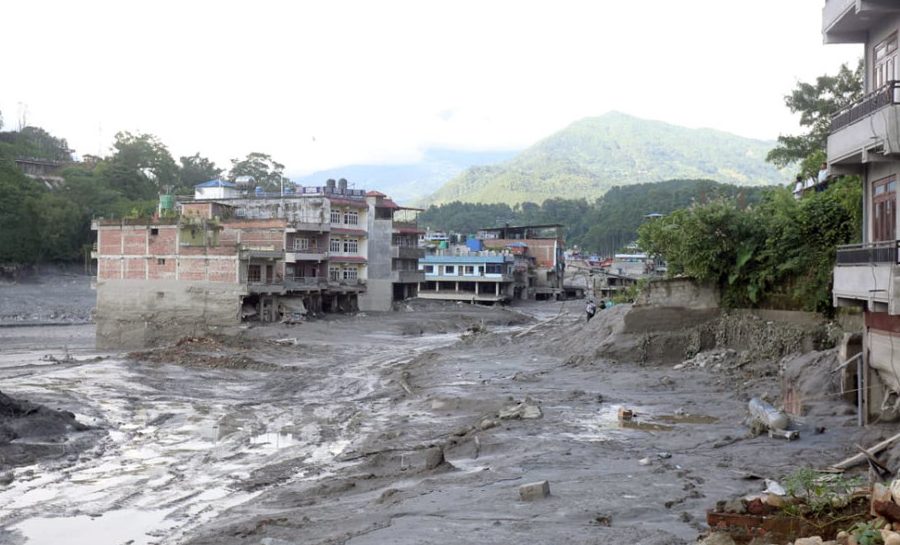
Recent disasters—such as the devastating floods and landslides in Manang, Mustang, and the Terai region—demand urgent adaptation strategies, not just symbolic mitigation plans. Research into these events and localized risk reduction should be immediate priorities, but they receive minimal attention in the NDC.

Leadership or Performance?
Nepal’s active participation in climate summits—from Glasgow to Azerbaijan—has been noticeable. However, this enthusiasm has yet to translate into meaningful domestic action. Climate diplomacy trips have often become opportunities for official delegations to travel abroad rather than push for substantive gains for Nepal’s climate agenda. Ministries, particularly the Ministry of Forests and Environment, appear more focused on international appearances than on initiating necessary policy reforms and research at home.
True leadership demands that Nepal champions the cause of vulnerable countries with courage—not merely performs on the global stage. There must be a fundamental shift from acting for appearances to delivering tangible results.
Net-Zero Goals: Real Progress or Aid-Driven Strategy?
The net-zero emissions target is noble, but is it achievable—or merely a strategy to attract grants and aid? If Nepal is serious about leadership, it must demonstrate it through action.
For example, have local governments been empowered to develop their own climate policies? Have adaptation budgets been allocated based on actual disaster risk profiles? Sadly, the answers often remain unclear. Nepal needs to empower municipalities to manage climate risks proactively, provide them with clear funding, and ensure transparency in climate financing mechanisms like the Loss and Damage Fund.
Inclusive Promises Amidst Stark Realities
NDC-3 does acknowledge inclusion, aiming to empower women, youth, Dalits, indigenous peoples, and marginalized communities in climate planning and monitoring. It also proposes integrating climate education into formal schooling from an early stage—an important long-term step. Plans to promote green startups among rural youth and incentivize climate-smart agriculture and renewable energy investments through tax reliefs have also been outlined.
However, these good intentions are marred by a lack of clarity and budgetary commitment. The plans appear ambitious but underfunded. Without internal resource mobilization, Nepal’s heavy reliance on external aid risks making its climate policies unstable and ineffective.
The Execution Gap: Finance, Coordination, and Capacity
NDC-3 estimates a whopping $89 billion will be needed to achieve its targets, but there is no clear financial roadmap. Local governments lack training to implement climate plans, inter-ministerial coordination remains weak, and Nepal’s political instability hampers long-term policy continuity.
Applying one-size-fits-all strategies across all provinces ignores Nepal’s vast geographical, socio-economic, and climate diversity. For example, Karnali and Sudurpashchim Provinces face different climate risks and poverty levels, demanding localized solutions rather than blanket policies.
Participation is often more rhetorical than real. Representation without decision-making power cannot be equated with true inclusivity.

The Way Forward
To transform NDC-3 into a genuine blueprint for climate justice, Nepal must:
Balance priorities between adaptation, mitigation, and loss and damage.
Make climate finance transparent, inclusive, and results-oriented.
Empower local governments and communities with budget ownership and capacity-building.
Focus more on indigenous innovation and internal resource mobilization rather than foreign aid dependence.
Shift from “messaging” to “delivering results” in climate action.
Nepal has sent a strong message through NDC-3: “We are ready to be part of the climate solution.” But if this message remains image-driven rather than reality-based, it will ultimately weaken the pursuit of climate justice.
The climate crisis is not a distant threat—it is already in our rivers, villages, fields, and communities. It is time to stop counting disasters and start confronting them with policies rooted in reality, justice, and resilience.


यो खबर पढेर तपाईलाई कस्तो महसुस भयो ?
[WPAC_LIKE_SYSTEM]प्रतिक्रिया
सम्बन्धित खवर