Written by : Rezina Tuladhar
An impactful health awareness event was recently organized by Nepal Cancer Niwaran Pratisthan in collaboration with the Federation of Nepalese Indigenous Nationalities Journalists. The program brought together medical experts to discuss three major types of cancer affecting Nepalese communities: breast cancer, prostate cancer, and cervical cancer. The event emphasized the importance of early detection, regular screening, and public education.
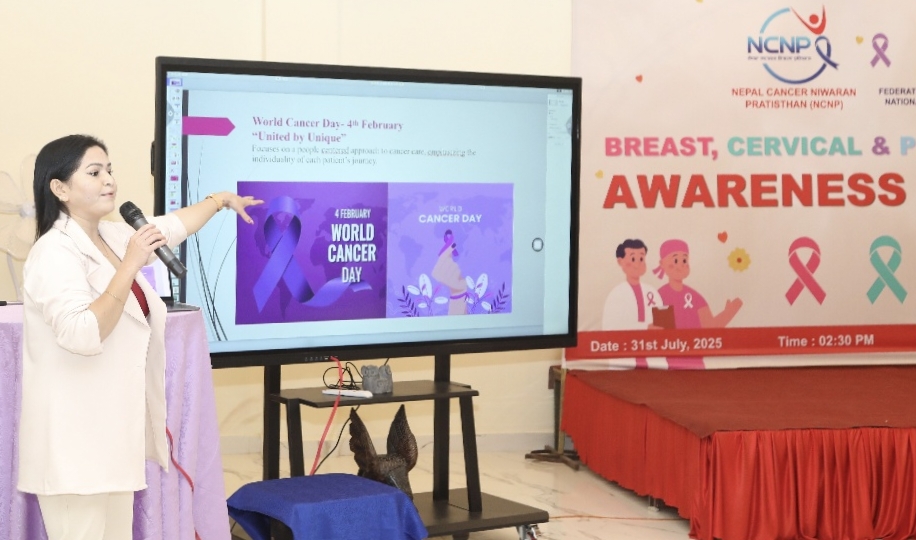
Breast cancer was addressed by Dr. Praful Shakya from KCC, who highlighted a concerning statistic: while breast cancer accounts for only 4% of cases abroad, it makes up 19% in Nepal. He advised women to check for lumps after their menstrual cycle and recommended annual mammograms and video X-rays for those above 35. Although nipple discharge before menstruation can occur, it is not always a cause for alarm. Dr. Shakya clarified that breast cancer is often painless, and pain in the bone upon touch may indicate a more serious condition. He also noted that breast cysts—of which there are three types—are natural changes and not diseases. Reconstruction after breast cancer is possible, though sensation may not return. Importantly, he dispelled myths such as the belief that squeezing a newborn boy’s nipple is necessary, urging people to avoid such practices.
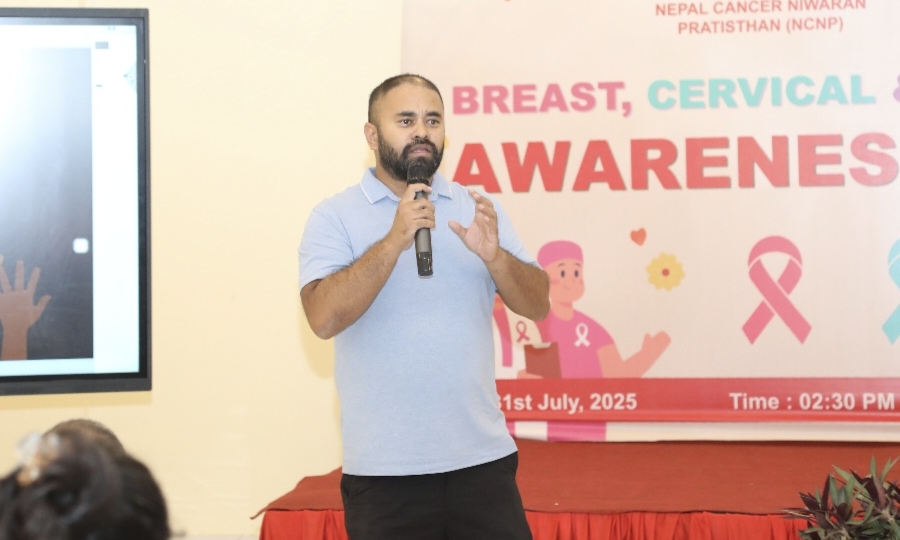
Prostate cancer was discussed by Dr. Ishan Malla, a Uro-Oncologist and Andrologist. He explained that a healthy prostate is about the size of a walnut, and its enlargement does not always signal cancer. Prostate issues typically begin after age 50 and may not show symptoms immediately. Nepal records approximately 2.9 new cases per 100,000 people annually, with a 47.62% increase in cases from 1990 to 2017. Dr. Malla stressed the importance of screening, especially for individuals with a family history of prostate cancer. Men whose father or brother has had the disease are at higher risk and should undergo regular checkups.

Cervical cancer was presented by Dr. Rajani Jha from KMC and KCC. Her message was clear: “Get informed, get screened, get vaccinated.” She emphasized that even stage 2 cervical cancer is curable if detected early. The PAP smear test is a vital tool for confirming the presence of cervical cancer and should be done every three years starting at age 21. While not all HPV infections lead to cancer, high-risk strains can be dangerous. Dr. Jha recommended two vaccines—Cervarix and Gardasil—as effective preventive measures. She also highlighted the importance of understanding the role of the ovaries in women’s health and encouraged regular screening to protect against cervical cancer.


यो खबर पढेर तपाईलाई कस्तो महसुस भयो ?
[WPAC_LIKE_SYSTEM]प्रतिक्रिया
सम्बन्धित खवर