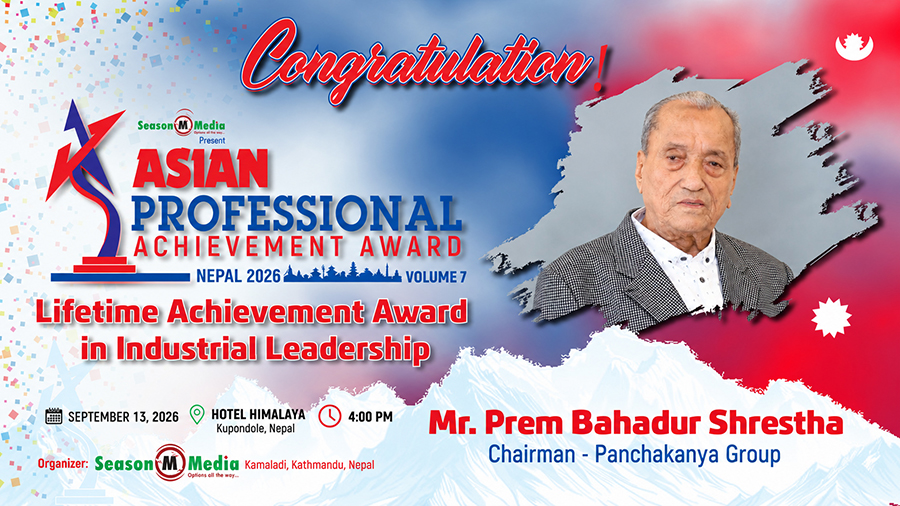
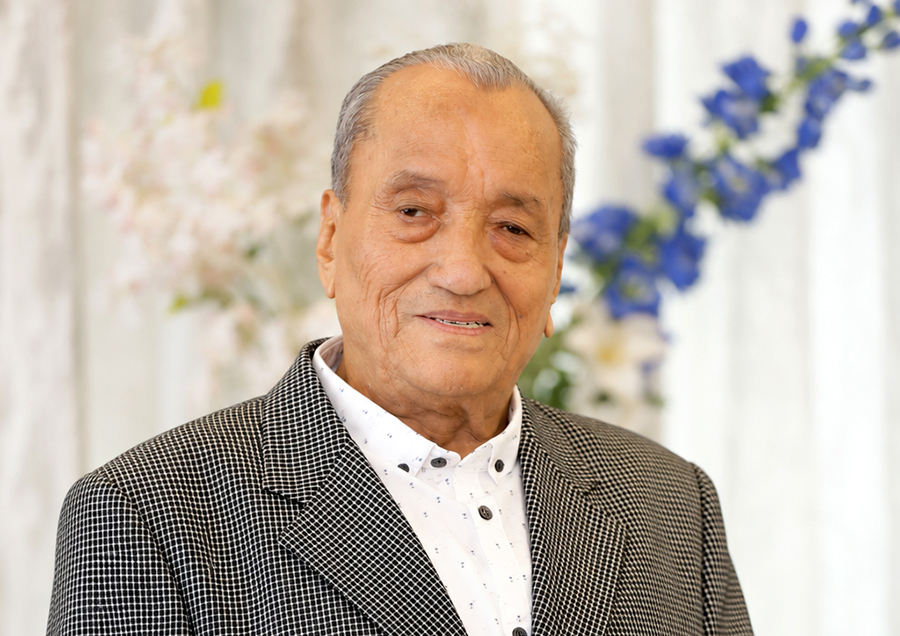
Every successful entrepreneur has a beginning, but few beginnings are shaped as profoundly by responsibility and hardship as that of Prem Bahadur Shrestha, founder of Panchakanya Industries. His journey from a young trader carrying family responsibilities to a prominent industrialist represents perseverance, calculated risk-taking, entrepreneurial vision and a sustained commitment to Nepal’s industrial development.
Born on Bhadra 15, 1988 B.S., in Ilam Bazaar to Tej Bahadur Shrestha and Mohanmaya Shrestha, Shrestha experienced responsibility at an early age. Following the death of his father in 2006 B.S., he assumed responsibility for his younger brothers and sisters. This formative experience instilled in him a strong sense of discipline, accountability and determination—qualities that would later define his professional and personal journey.
From Trading to Manufacturing
Shrestha entered business in 2008 B.S., beginning with the trading of potatoes, cardamom, timber, textiles and groceries. Although modest in scale, these early ventures provided practical knowledge of markets, customers, procurement, supply chains and commercial management.
Between 2011 and 2012 B.S., he operated a rice and grain warehouse in Jhapa, buying and selling paddy and rice. In 2013 B.S., he established a textile and grocery shop in Fikkal, Ilam. He later entered the timber business in Jhapa under a government contract in 2022 B.S., with timber eventually exported to India and Bangladesh.
These experiences gradually expanded his commercial perspective. He began to recognize that Nepal’s long-term economic progress required stronger domestic manufacturing rather than continued dependence on imported products.
A major milestone came in 2029 B.S., when he established a modern automated rice mill at Charpane, Birtamod. The mill supplied the domestic market and exported rice to India, marking his transition from trading commodities to manufacturing products.
Building an Industrial Legacy
Shrestha’s most significant industrial chapter began with his entry into iron and steel manufacturing. Nepal’s dependence on imported construction materials, combined with increasing infrastructure development, presented both a challenge and an opportunity.
The industrial environment was demanding. Limited transportation infrastructure, difficult access to financing, imported raw materials and an underdeveloped manufacturing ecosystem created substantial obstacles. Nevertheless, Shrestha believed Nepal had the capacity to develop its own industrial base.
In 2039 B.S., he established Panchakanya Iron Industries at Kotihawa, Bhairahawa. The enterprise became a cornerstone of his industrial career and provided the foundation for further diversification.
Around 2040–2041 B.S., the group entered the production of HDPE pipes, followed by PVC pipes and fittings. The guiding principle was straightforward: products that Nepal was importing should, wherever technically and commercially viable, be produced domestically.
This philosophy transformed business opportunities into broader economic contributions through employment generation, domestic production and the strengthening of Nepal’s industrial ecosystem.
His interests subsequently expanded beyond manufacturing. During the government’s privatization process, Panchakanya became involved in Butwal Power Company through private partnership. The group also took responsibility for operating the Nepal Bitumen and Barrel Industry. These experiences reinforced Shrestha’s emphasis on professional management, operational efficiency and long-term commitment.
Diversification into Energy
Shrestha’s entrepreneurial vision also extended into the energy sector. During Nepal’s prolonged electricity crisis and load-shedding period, he supported hydropower development. With a particular desire to contribute to his birthplace, projects with capacities of 10 MW and 5 MW were initiated in Maijhuwa, Ilam.
His industrial interests also included the production of LPG gas cylinders in Amlekhgunj, further expanding his contribution to domestic manufacturing.
His diversified investments demonstrate an entrepreneurial philosophy that connects commercial activity with national development. Manufacturing, energy and infrastructure can create employment, strengthen supply chains, develop technical skills and reduce dependence on imports.
Industry with Social Responsibility
For Shrestha, business success has never been measured exclusively in financial terms. Social responsibility and community contribution have remained important elements of his philosophy.
Over the years, he has supported education, healthcare, community infrastructure and humanitarian initiatives. He is a lifetime member of the Nepal Red Cross Society and has been associated with various social organizations.
Education has been one of his most significant areas of contribution. In 2032 B.S., he helped establish a primary school in Charpane, Jhapa, named after his mother, Mohanmaya, and later supported the construction of its school building.
He has also served as Chairman of the Board of Directors of Lalitpur Multiple Campus since 2064–65 B.S., contributing to institutional infrastructure and educational development. His support has extended to educational institutions in Bhairahawa, Rupandehi, Bara, Kavrepalanchok and Sindhupalchok, including assistance for school and campus buildings.
His commitment to education extends to research and innovation. He supported the Panchakanya Technology Innovation Research Grant at the Nepal Academy of Science and Technology, encouraging research, technological advancement and innovation.
His social contributions have also included healthcare and community infrastructure. He has supported facilities at Mechi Hospital in Chandragadhi Bhadrapur, assisted shelters for vulnerable elderly people, and contributed to the construction and renovation of temples, rest houses and other community facilities.
In Ilam, he supported the renovation of the Panchakanya Temple in Karfok. His community engagement has also included environmental initiatives such as tree planting and humanitarian activities including blood donation.
A Journey Rooted in Responsibility
Behind the industrialist is a family man whose early hardships influenced his values. He married Nil Kumari Shrestha in 2012 B.S. and has three sons and one daughter. The responsibility he assumed after his father’s death appears to have shaped his approach to family, business and society alike.
Discipline, accountability, perseverance and responsibility became not merely professional principles but integral elements of his character.
His life demonstrates that successful entrepreneurship does not necessarily begin with wealth or privilege. It can begin with a modest business, difficult circumstances and the determination to persevere.
From trading potatoes and cardamom to establishing manufacturing enterprises; from rice milling to iron and steel; from pipes and industrial products to hydropower and energy-related ventures, Shrestha’s career illustrates the evolution of a businessman into an industrial entrepreneur.
Yet his legacy extends beyond factories and commercial enterprises. The schools, healthcare facilities, community infrastructure, research initiatives and humanitarian activities associated with his contributions reveal a broader philosophy: economic success gains greater significance when it creates opportunities and benefits society.
Prem Bahadur Shrestha’s journey is therefore a story of transformation—adversity into determination, determination into enterprise, enterprise into industrial development, and success into social responsibility.
For Nepal’s emerging generation of entrepreneurs, his life offers a compelling lesson: the circumstances in which a journey begins do not determine where it must end. Courage to begin, patience to persevere and a commitment to serve society can transform difficult beginnings into a lasting legacy.
यो खबर पढेर तपाईलाई कस्तो महसुस भयो ?
[WPAC_LIKE_SYSTEM]प्रतिक्रिया
सम्बन्धित खवर